Wednesday, December 28, 2011

    Lunch with Hackers & Founders


    One of the perks of working at Wednesdays.com is that I get to go to the lunches I organize for free.  Last week, I decided to attend a lunch run by Hackers & Founders (H&F), a startup club with a huge membership in the Valley.  H&F lunches usually draw a predominantly developer crowd, meaning that I get lost in most of the conversations. 

    However, that week in Berkeley it seemed everybody had a very different backgrounds.  At the table was an owner of a co-working space, a financial advisor from Merrill-Lynch, a German who had just come to SF three days ago after working in Shanghai for five years, a founder of an early stage startup, a recent TechStars admit and me the Galactic Emperor/Ops guy from Wednesdays.com.  This diverse crowd had some of the most insightful conversations about startups that I have ever been part of.  Too many topics were covered for this blog post, so I will limit it to the two things that stood out.

    How to hire a developer
    It is no secret that the Valley has a huge shortage of developers/coders.  I have heard much about the high salaries and extravagant perks that companies have been offering to bring in talent.  As of last Wednesday, I did not think there was a way out of the status quo, besides perhaps dramatically increasing the amount of developers via education or immigration.  Enter Kyle the tech stars admit.  As a talented developer himself, Kyle had a fresh and most important of all, a credible solution to the problem. 

    Kyle’s solution was to hire developers to work part time.  He explained that developers love side projects, and are willing to work on them if given the chance.  The problem is that no company is giving them that chance because they only want the developer full time via a 40+ hour work week.  Kyle believes that employers should settle to hire developers for 10-15 hours a week rather than try to monopolize all their time.  He admits that this does have limitations, but to him it is the difference between having some talent to build product versus none at all. 

    I can think of a couple of pitfalls to his idea, but none that could not be resolved given time.  The idea of more using part time developers is very interesting to me and I hope it will be further explored.  God knows, there are a lot of great ideas out there that are simply not able to be built due to a lack of technical expertise.

    Silicon Valley Lingo
    The Valley’s lingo was on full display at the H&F lunch.  After six months on the job at Wednesdays.com and spending countless hours on startup blogs, I finally have gotten a hang on the startup lingo. 

    At lunch, I felt like I was in the “in” crowd, throwing around technical terms like NFC (Near Field Communication), GUI (pronounced: Gooey) as well as name dropping luminaries and accelerators such as Eric Ries, Brad Feld, and YC.  Glad to know that after leaving the Valley for three months, that I had not missed a beat.    

    At times, the German from Shanghai had trouble understanding us.  Whenever he asked us to clarify a term or name, it just reminded me of how much of a bubble Silicon Valley can be.   And I have to say it is a great bubble.  

    Closing Thoughts
    The quality of these lunches just keep increasing and I was thankful I got a chance to attend one, while I was on vacation.  Here's to the new year and may there be many more enlightening lunches for this group of Hackers & Founders.

    Monday, November 14, 2011

    My Networking Story

    Last Monday, I got an email from my boss

    Hey – this just came out. Big kudos to Jonathan for helping!
    http://www.slideshare.net/bowei/the-china-startup-report-a-15min-crash-course-by-bowei-gai
    -H

    It was a link to a presentation on the startup scene in China and on the “Special Thanks” slide was my name.

    Is that really my name there?

    Looking at this slide with my name tagged with 500 Startups, I am amazed by how far I have come. To think that while still in college, I would have meaningful professional connections that could help someone. It just leaves me speechless.

    Just a year ago, I could not drop a name to save my life. There were no relationships with professors or even high school teachers to speak of. Only when I needed a letter of recommendation to study abroad did I have my first real conversation with a professor and that relationship died as soon as he wrote that letter.

    My first attempt at real networking was during my political internship in Los Angeles. The internship coordinator pushed my intern class to go forth and network any chance we got. The plan was for me to collect as many cards as I could while being as memorable as possible and then email the card givers the next day telling them how much I enjoyed meeting them. For my efforts that summer, I ended up with a large collection of business cards, but only one of those cards ever ended up in a meaningful conversation. Something just was not working.

    While studying abroad in Shanghai, I made no effort to network because I believed that it would be meaningless since I would be gone in a year. I started going to networking events for the drink specials and guest speakers, making no effort to schmooze anyone into giving me their business card. Surprisingly, during my stay in Shanghai I made significantly more connections than at any other point in my life.

    Thinking back, I realize there were two reasons for the explosion in connections. First, by not having networking be the end goal of meeting someone, my interactions upon meeting people for the first time became much more genuine. I cracked jokes, talked about my personal life and was just generally much more relaxed. This helped people warm up to me quickly, allowing for a connection to happen organically. Second, I got involved in a non-profit and Toastmasters. Through these two organizations, people would not only see more and more of my personality meeting after meeting, but also see the kind of skills I brought to the table through the work I did for the organization. Cementing everything together was the understanding that we were all working towards a common goal, which made the relationships extra meaningful and more resilient.

    In short, if you want to make meaningful connections, skip the networking events and cocktail parties. Just keep it real and get involved.


    Monday, November 7, 2011

    Study Abroad Advice for China

    20101007-DSC_0023
    Pudong, Shanghai built in just the last 20 years

    From September 2010 to July 2011, I studied abroad in Shanghai (SH) at Fudan University. I experienced a very different China from my classmates and the experience opened up my eyes and radically changed my perception of the country and culture. Recently, I was asked about my experience by a prospective study abroad student who was planning on going to China. The advice I gave her did not seem to do my experience justice so I was compelled to finish this post that has been on draft for weeks.

    This is what I would tell every American student looking to study abroad in China:

    Breadth vs. depth
    Early on you will have to decide what kind of experience you want from China. The amount of time you have is severely limited meaning that you will have to decide between breadth or depth. China is a large country with many sights to see and at the same time is an incredibly complex society with many layers. It is a zero sum game in that seeing sights will mean understanding fewer layers and vice versa.

    DSC_0178
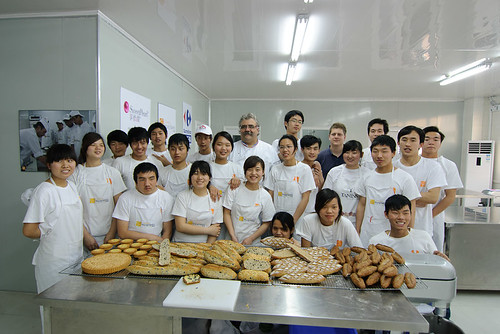
    The class of Shanghai Young Bakers with French master chef Pascal Tepper

    After backpacking for a week, I realized I was not much of a backpacker and opted to spend the large majority of my time in SH. I got involved in a nonprofit called Shanghai Young Bakers, as well as joining a local Toastmasters chapter. A lot of my time was spent exploring and trying to understand different parts of the city. I got off the tourist path and started acting like a resident, attending expat networking events, non-profit fundraisers, gallery openings. I even became a recognized regular at a café!

    20101024-DSC_0003
    Sometimes, the art was in some strange places like this former opium storage facility

    20110112-DSC_0065
    Other times, it just got creepy

    This all came at a cost, as I skipped out on many of the things people expect you to see while you are in China, like the Great Wall, Forbidden Palace, and terracotta warriors just to name a few. I certainly saw the least tourist attractions out of all my classmates, but I do not regret it as I was able to see a China that was not in the tourist books. For instance, as part of Shanghai Young Bakers I was able to travel through AIDS impacted rural China and hear the stories of working class people my own age.

    DSC_0163
    In rural China, sometimes getting off the beaten path means not much of a path at all

    Learning Chinese
    Not understanding Chinese, does not mean that you cannot get off the beaten path. First tier cities, like Beijing and Shanghai have large expat populations that will allow non-Chinese speakers to do unique and non-touristy things, such as partake in the local art scene. However, not understanding Chinese does severely limit your interactions and understanding of the locals.

    Learning Chinese is an extremely time consuming process that will cut into your time exploring and experiencing the country. My advice for learning Chinese is to skip the university classes, which are largely impractical and instead hire one of the many student tutors. Also focus solely on learning to speak and pin yin, as these will immediately y improve your ability to interact with locals and get around the country. Armed with a smartphone or iPod touch loaded with Chinese-English apps and a rudimentary understanding of Chinese, you will be able to survive 80% of your day to day interactions. For the other 20% just guess and hope for the best, it is more fun that way anyway.

    Do things alone
    The truth is that no matter how many friends you may have, there will be many instances where due to school, work or just general disinterest, they will not be accompanying you to what you want to do. Many times, I found myself at an event or wandering alone in SH, and though it definitely would have been more fun with some company, I never regretted it. Do not wait upon others to do what you want, or else you will miss out on a lot. Also, one plus of going alone is that it opens you up to making new and unexpected friends.

    Hang with non-Americans
    20100912-IMG_1122
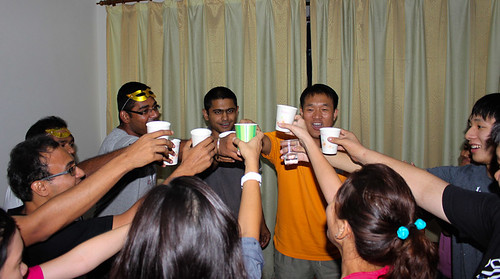
    Nationalities represented at my birthday party: American, Canadian, Chinese, French, Indian, Korean, Singaporean and Thai

    Arriving in a foreign land like China where you do not understand the language, the immediate impulse is to attach yourself with the familiar. I saw this happen with my classmates who mainly hung out with each other in large groups. This did not make much sense to me because I had not traveled thousands of miles to interact with more Californians. Due to my insistence on minimizing the amount of time I spent with Americans, I spent my first semester with a very international group of MBA students and then later with Singaporean exchange students. The most valuable thing I walked away with after a year in China was not the experiences or knowledge, but the friends I made that came from all across Asia.


    Friday, October 21, 2011

    My advice for your first day: Don’t be a robot


    This post was first published at the InternMatch Blog and it is my first guest post on that blog.  Please head over to the link, FB Like and Tweet it because it contributes to my coffee fund.  If you are interested in writing for InternMatch, fill out their app!
    This post has been on draft for a while and recently, I have been inspired to complete it after being asked by a friend for a ride to an interview.  For many, the beginning of school is marked by first time jobs and most people including me were incredibly nervous and unsure about how to act on our first day. 

    I searched on Google on what to do for my first day and saw that it was a topic that has been thoroughly explored.   However, no matter how much you read, it is always the same few things that show up:
    •             Dress appropriately
    •             Arrive early
    •             Ask Questions
    •             Do your homework on the company
    •             Be positive/upbeat/have a good attitude

    Following that advice you will be alright, you might even do very well! However, after working a few internships, that first day advice seems to be missing something.  Perhaps, it is because I am anthropology major and was taught the value of personal connections, because to me those points of advice miss that very important aspect of being human.  It is my opinion that the first day of work should be about laying the foundation for not only a professional connection, but a friendship as well in order to create a lasting relationship.

    There are three things that I would recommend someone to do on their first day:

    1) Be a chatterbox
    As soon as you are shown to your desk/cubicle/place of work, immediately talk to the people around you.  Remember how eager you were to make friends on your first day of college by striking up conversations with everybody?  Capture that same mindset and use it to develop friendships on your first day of work.  Revealing things about yourself through conversation, even something as simple as what you did that weekend, helps your coworkers find common ground with you and allows for the beginning of a relationship.       

    2) Be a great listener
    In a conversation is important to take as much as you give, meaning that simply chatting away about yourself will get you labeled annoying, conversely if all you do is listen it will kill the conversation.   The key to being a great listener is not just to passively listen, but also actively ask questions and give affirmations as well.  If you listen well, I think you will be pleasantly surprised to find how much people will tell you about themselves.  A receptive ear is always welcome and the sooner you demonstrate you have one, the more quickly you will be able to gain people’s trust and develop a relationship.

    3) Keep it real
     Genuine people are greatly appreciated and fakes can be spotted a mile away.  Therefore if you do not have a genuine interest in being friends with your coworkers, your execution of the first two points I listed will fail.  Stay honest and be yourself as you interact with your coworkers and you will be making friends with them in no time.
              
    In closing, remember to use you heart as well as your brain and I wish you a fantastic first day,

    Jonathan

    Monday, October 17, 2011

    Marketing Binder Entry #4: Campus Crusade for Christ Booklet

    I was awaiting the start of my weekly Wednesdays conference call when two members of the Korean Campus Crusade for Christ (KCCC) came up to me and asked for five minutes of my time.  After a couple of refusals, their persistence paid off and I finally relented and let them preach to me.  One of the members whipped out his trusty booklet and began reading from it.

    That is when I noticed how terribly done their sales collateral was.

    Long, tacky title with an uninspired font and color scheme. And that's just the beginning!  See the whole booklet here

    Have You Heard of the Four Spiritual Laws? is a booklet published by the Campus Crusade for Christ (CCC) and the whole design of the booklet just screams amateur.  It looks like something someone whipped up on Microsoft Word 97 and then never got around to updating it for the new millennium.

    Below are two pages from the booklet:


    There are a host of problems with them, but the most notable are:

    1. Lack of color - I imagine CCC is already paying for color printing due to the yellow, so why not use other colors to spruce up the text and make things pop?  Also images in black and white in this day and age of cheap color printing is a crime.
    2. Text heavy/bad formatting - Shorter headers and bullet points would have helped the reader grasp the message more quickly.  Overly repetitious headers, pushes the reader to gloss over the material.  The last paragraph should have been broken up into bullets not only for the reader, but for the presenter of the booklet as well.  Bullets in the form of incomplete sentences force the presenter to put things in their own words, making the whole presentation much more interesting and lively.  Reading a sales pitch in front of someone is a surefire way to lose a sale.  
    3. Confusing image - There are too many elements in the image to grasp at a glance.  It fails to convey to the reader immediately how they are missing out on happiness due to the lack of Christ.  
    4. Fails to answer "So What?" - The text fails to make immediately clear what is the benefit for receiving Christ.  Reading through the headers and quotes the reader is left asking so what? The value proposition is simply not there. 

    Closing thoughts
    The flyers and posters put up by other Christian groups such as Intervarsity and they just blow what KCCC does out of the water.  It is a hyper competitive market out on the UCSD campus with dozens of fellowships and churches vying for converts.  Having subpar collateral is just not going to cut it.  

    Monday, October 3, 2011

    Daily deal folly at UCSD or just a genius marketing ploy?


    I thought the daily deals marketing concept pioneered by Groupon had already been thoroughly debunked.  However, when I got back to UCSD I heard my friends buzzing about a new daily deals site called Munch On Me.  According to TechCrunch, Munch On Me is an YC startup that is the "Groupon for food."   The “key” difference and advantage Munch On Me has over Groupon is that it gives deals on specific items rather than dollar amounts letting restaurants stock up on a particular item, which leaves them much more prepared to handle the spike in traffic.  It looks like they just recently expanded to San Diego and are offering quite a lot free items on their site.   Munch On Me has even managed to get my on campus Tapioca Express on board.  For over a week, the UCSD Tapioca Express is offering a free pearl milk tea with no purchase necessary. 

    I question what Tapioca Express hopes to accomplish out of this promotion.  The theory behind daily deals is that by driving a massive amount of traffic to a store through a “too good to be true” deal, will result people in discovering the store and then turn them into repeat customers once they realize how awesome the store is.  Munch On Me must have a great sales team to be able to convince Tapioca Express that it needed to be discovered, considering that it is the only milk tea shop on campus with the next closest one being a 10 minute drive, 20 minute bus ride or 30+ minute walk from the center of campus.  In other words, if you are on campus at UCSD, you do not have a choice but to go to Tapioca Express for your milk tea, making the act of running a free milk tea promotion with no purchase necessary, sort of a puzzle.  I reckon money would have been better spent on something as simple as a flyer.       

    This promotion only makes sense, if Munch On Me is paying Tapioca Express for the promotion in order to drive traffic to the site.  As one of the most highly trafficked stores on campus, a Tapioca Express promotion would drive a lot of traffic from UCSD students to Much On Me.  It would be an ingenious way to get that word of mouth effect going overnight.  

    Wednesday, September 28, 2011

    My first time on a panel: Arsalyn Youth Forum

    Out of nowhere, I got an invitation from CAUSE to join in an arsalyn youth forum and sit on a panel in front of 150 high school students.  The title of the discussion was Social Media, Civic Engagement and You!  and at first, I was hesitant to jump in due to doubts about how much value I could add.  I certainly had SOME experience with social media, but was it enough to sit on a panel and talk about it? Not to mention, when putting social media into a civic context, I had even LESS to share.

    The young audience

    This doubt about adding value was further magnified on the day of the event, when I read the bios of my fellow panelists.  At the panel table, sitting with me was Diana Nguyen (blogger for the Huffington Post and co-author of DISGRASIAN.com), Diane Ellis (lead editor of ricochet.com), Ayofemi Kirby (Director of Strategy and Programs for mobilize.org), and last but not least there was Kristina Lieu (Friend and fellow CASIC intern of class 2010). These rather distinguished panelists, had years of experience and accomplishments over me and in the beginning it was a bit intimidating.  However, after the first few questions, I realized I contributed the ever important student perspective to the panel and began to relax. 

    The distinguished panel

    As the discussion progressed, I was wary about what VC Brad Feld had wrote about panels usually being “dull, vapid, generic, stupid, non-controversial, politically correct, or just plain boring."  At the halfway mark, I felt that as a panel we were not boring but definitely non-controversial since we agreed on every question.  After that realization, I decided to throw caution to the wind and try to be humorous by keeping my answers off the cuff.

    When asked about the shutting down of social networks during the Arab revolutions, I started off with “it sucks," which caught the audience off guard as everyone else on the panel was using fairly formal language.  In another instance, a student asked what news sites had no bias and I joked “well I can tell you that it’s not Fox news.”

     My best line of the night came as a response to a question about whether FB liking or retweeting gave people just enough satisfaction that they would stop contributing to a cause because they felt like they had done their part.  I bluntly told the audience that anyone who felt they did their part by just clicking a button was probably not going to contribute that much anyway.  Furthermore, I explained that slacktivism has some benefits including getting the word out and more importantly providing positive reinforcement for the people behind the cause.  I closed by telling the students "I don’t know if it is just because I am a geek but when I get retweeted, it makes my DAY,” which in addition to illustrating my point got a lot of laughs. 

    I had a whole lot of fun speaking on the panel and hope I was not too over the top that they will not invite me back.  After all, making people laugh and dropping knowledge, what else could I ask for on a Saturday night?    


    CAUSE team