Showing posts with label San Diego. Show all posts
    Showing posts with label San Diego. Show all posts

    Monday, January 7, 2013

    Internship City Guides

    The most enjoyable projects I worked on during my time at InternMatch has got to be the summer internship city guides.  It was not challenging work, but it was a ton of fun researching housing, dining and entertainment in NYC and San Diego.

    I wrote my first city guide on San Diego back when I was still an intern and still a student at UCSD.  It seems fitting that I end my time at InternMatch by publishing a New York City guide.
    Enhanced by Zemanta

    Tuesday, June 26, 2012

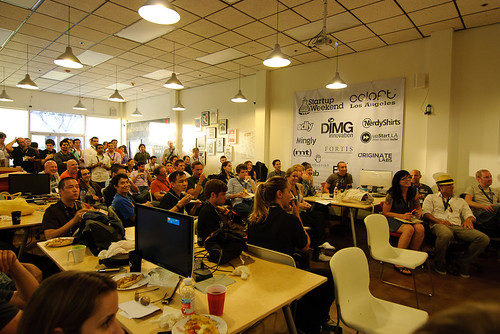
    Takeaways from Startup Weekend San Diego #SWSD

    Last week, was San Diego's 4th Startup Weekend, here are my thoughts on the event as part of the organizing team.

    Organizing the event

    The organizing team was decently sized and that meant the workload ended up being very manageable.  Though, I kind of wished I had taken on more responsibility.  Nonetheless, organizing SWSD was an incredibly rewarding experience.  It helped that the attendees were incredibly appreciative of the organizing team.  On Sunday night after SWSD wrapped up, we joined some of the attendees at the bar and when we entered through the door they gave us a round of applause!  That one moment made all the hard work and fatigue worth it.

    Friday pitches

    As much as I tried to, I could not like the pitches on Friday night. After witnessing the originality of the pitches from Startup Weekend Santa Barbara, the San Diego pitches just seemed stale.  Most of the ideas pitched seemed to be minor variations on already well established products.

    Inside the judges room

    I found myself disagreeing with the judges on the winners.  Aside from GeoContractor, an app for contractors to keep track of where their workers and materials are, I thought the judges really missed the boat.  The first place winner Remix Replay was a website to create web games via a drag and drop interface.  According to the judges, Remix Replay was not ready to immediately go to market judging by the demo presented, in addition, it had no clear monetization strategy.  This made it all the more surprising, when the judges selected Remix Replay for first place over GeoContractor, when GeoContractor's product was at the same stage but had a clear monetization plan for the huge contractor market.

    Qualcomm ContextBeta SDK Winners

    On the other hand, I completely agreed with the selection of Breadcrumbs for the first place ContextBeta SDK prize.  This smartphone app which tracks a users movement throughout the day and then breaks that data down into easily understood and relevant chunks, fits well with the growing trend of quantified self.  Its monetization strategy also fits well with the trend of localization of ads.  The data that Breadcrumbs would have access to such as when and where a user is, as well as how long he is going to stay there and where he is going to go next would be extremely valuable to an advertiser.

    Conclusion 

    SWSD did not start off strong, but it certainly made a good showing in the end.  There were a couple of products such as GeoContractor, Breadcrumbs and Backdropp that I would love to try.  However, after Santa Barbara, I must say that San Diego has some serious catching up to do.  

    Monday, June 25, 2012

    Startup Weekend San Diego #SWSD: Competing Teams and Winners


    Startup Weekend San Diego (SWSD) was just last week and I was part of the organizing team.  

    Below are the winners as well as a list of the teams that formed:

    SWSD Winners

    1st place: RemixReplay
    2nd place: GeoConstructor
    3rd place: StokeBox

    Crowd Favorite: CollegeGoGo
    Runners-up: GeoConstructor, RemixReplay

    Qualcomm Labs - ContextBeta SDK winners: 

    1st place: Breadcrumbs
    2nd place: GeoConstructor
    3rd place: SafeAlert

    Competing teams:

    F-ParkingTickets
    Startup company building a system to save us all from parking tickets.

    Stoke Box
    An online community of parents that matches members based on what they have and what they need.


    People Are Waiting
    Communicate effectively with latecomers to meetings and quickly decide if you should start without them, reschedule, or wait.


    SafeAlert
    A service that provides alerts of a crime that are taking place in the vicinity in real time, so that you can stay away from the location of crime.

    LocalWall
    Digg based event posting community.

    GeoContractor
    Automatically locates employees and subcontractors for Construction General Contractors and Developers. Automatically checks them in and out of job sites and hardware stores. Allows workers to establish lists of supplies to pick up, and automatically pops up this list when the worker enters the geolocation. 

    Tour Me
    Location-aware mobile app platform for cultural institutions.

    backdropp
    A geotag solution to location scouting for the creative community.
    Backdropp allows the user to pin a cool location on the map, attach a photo of the point of interest and write a short description. Our geotag system alerts other users when they are in the vicinity of that backdrop so they can check it out and utilize that backdrop for photo shoots or location scouting.

    Breadcrumbs TBD
    Working with geo fence technology.

    College Go Go 
    A college registry site and app for students. 

    TravelShot
    TravelShot is an interactive travel photo journal and social network.  While traveling, TravelShot allows you to snap a photo and upload it to a personalized size that tracks your travels on a visual map filled with the photos you've taken along the way.  TravelShot is integrated with Facebook and Twitter to send out updates to your friends and family every time you post an update.  When you get home, you instantly have an interactive photo gallery of your travels.

    Solace.com
    Making the creation of online memorials easy for the bereaved.

    Remix Replay
    To create a web app that allows users to make personalized computer games. No programming skills required.

    WRIGHT
    A Jetshare Community

    Thursday, May 10, 2012

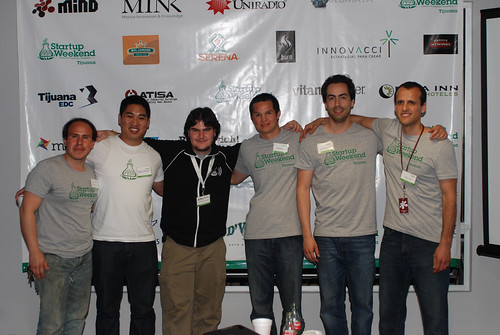
    Takeaways from Startup Weekend Tijuana (SWTJ)

    Coming to Tijuana for Startup Weekend was the first time I had ever set foot in Mexico, which now seems like a crime considering that I have lived less than an hour from the border for three years.  The people I met, talent I saw and food I ate has made me fall in love with the city, and has got me seriously considering if I want to live there for a bit sometime down the line.

    Below are some takeaways I got from SWTJ
     

    Wait what’s Startup Weekend (SW)?

    DSC_0348
    SWTJ organizers and Wes, my boss from Ansir Innovation Center
    Startup Weekend is a 54 hour competition, where attendees pitch a startup idea on Friday, form teams around the highest voted ideas and then build and hopefully launch that idea over the rest of the weekend.  Throughout the weekend, teams receive guidance from local entrepreneurs who volunteer their time.  On Sunday, the teams give a final pitch and are judged on what they have built.  Startup Weekend is a nonprofit organization that is funded by the Kaufman Foundation, which seeks to develop entrepreneurship around the world.  There have been SW events all over the world, from San Francisco to Shanghai and even Gaza.  Even more impressive, all the events have been organized by unpaid and overworked volunteers, so you know there is a lot of passion floating around every event.      

    “Wow this looks like China!”

    After crossing the border and seeing the shacks and rundown houses next to brand new glass office buildings and shopping malls, I was immediately reminded of China.  Tijuana (TJ) is no Shanghai, but with its cracks of modernity in an otherwise overwhelmingly developing city.  It looks like a 3rd or 4th tier city in the interior of China, maybe a Jingdezhen or Shangcai. 

    DSC_0388
    In the blue house right next to the MindHub office lives a family that raises roosters for cockfighting.
    With that in mind, I was really hoping to see Startup Weekend projects that would keep the average Mexican consumer in mind.  Talking to a few of the organizers and attendees before the initial pitches, I learned that broadband access is prohibitively expensive and furthermore very slow.  Someone told me that just 35% of Mexicans actually use the internet as compared to the US where it is around 60%.  In addition, smartphone penetration in Mexico is low and most smartphone owners did not have data plans, something which I noticed myself while interacting with the SW attendees.  I was also told that compared to most of Mexico, TJ was a bit ahead of the curve so internet usage and smartphone ownership was slightly above average. 

    Differences between American SWs and SWTJ

    Most of the mentors and organizers were in hardware or enterprise software, which is a huge difference from the US where I see mentors and organizers who are from predominantly consumer oriented web, mobile and local backgrounds.  In SWTJ, the large majority of attendees were developers and there was a huge shortage of business development talent, which is the complete opposite problem that I have witnessed in the US.  In addition, the SWTJ attendees seemed to be more one dimensional, only knowledgeable in their respective disciplines, than American SW attendees.    

    Facebook is King

    Jorge B., a social media marketer, said that social media in Mexico is dominated by Facebook and estimated that maybe 2% of Tijuanenses use Twitter.  Previously, Jorge’s marketing firm was located in San Diego and since moving to TJ he has noticed that there is big gap between US and Mexico in terms of talent and funding. 

    My one criticism

    DSC_0699
    Jorge
    MindHub Co-founder
    After the initial pitches and a late night snack of delicious street tacos, I expressed my disappointment about the lack of consideration for the average Mexican in nearly all of the ideas to Jorge, co-founder of MindHub which is the office which we were holding SWTJ at.  Jorge told me that he was not surprised since TJ is very different from the rest of Mexico due to its proximity to the border.  He explained the bicultural nature of the city and emphasized this by telling me that he “grew up watching Sesame Street.”  Jorge pointed to the relatively young age of the competitors combined with the biculturalism as the reason for the lack of connection to developing world problems. 


    Tijuana is not dangerous

    DSC_0370
    The only sign that there might be something going on.
    Before and after coming to TJ, I was asked and warned about it being dangerous.  However, when I talked to Omar, one of the organizers, about it I was told that there has not been a cartel shooting in over a year.  Omar explained that the violence still persists in cities like Juarez and Monterey but in TJ the only sign that there is a battle against the drug cartels are the occasional trucks of soldiers on the street.  Tourism from the US has not recovered since the explosion of violence, which is a shame, because it is safe and there are plenty of European and Mexican tourists who have realized this.

    I see a bright future

    DSC_0583
    Presenter from the winning SWTJ team
    On the last day of SWTJ, I asked a few of the organizers if they could name me one up and coming tech company in Mexico. No one could. After seeing the final pitches, I hope that will change because I was blown away by the results, especially in the design department. Perhaps, if San Diego and Tijuana pool their talents something amazing could happen sooner than later?


    Tuesday, April 24, 2012

    2nd place at Lean Startup Machine!

    It's 12:30AM right now and I still cannot believe that I won second place at Lean Startup Machine (LSM). Just 24 hours before, I had resigned myself to just trying to finish the workshop.

    Wait what’s LSM?
    Lean Startup Machine is a Friday through Sunday crash course on Eric Ries’s Lean Startup principles. People come together at 6PM Friday and pitch their idea to the rest of the attendees. The only requirement of pitches is that idea must not have had any work done on them. Pitches are voted on and the top 9 are allowed to form teams. Some came with their startups and pre-existing teams but their restriction was that for the weekend they had to work on ideas and they could not recruit new team members.

    After the teams were formed, we set forth to validate our idea for the rest of the weekend. Validation of an idea can come in many forms such as clicks on a buy button, signups for a notification once the product is launched, and the most coveted of all, actual money. Basically, teams had to show beyond a reasonable doubt that people wanted their idea and if no one wanted their original idea then they had to pivot (kill) or change the idea until somebody would.

    Back to me…
    My friend An (UX designer) and I came to LSM together with plans to work on the same team. We listened to the pitches and decided to join Dane, who had this idea for a check in app for pool boys. He explained that his friend runs a pool cleaning company and loses $20 thousand a year on disputed hours. An app that could prove when the pool boys arrived would solve his friend's problems. Two others joined our group and we set off brainstorming on how to validate.

    In the middle of a workshop, I made the observation that it might be hard to reach pool businesses on a weekend to validate our idea. The rest of the group agreed and we switched the idea to Yelp for yoga instructors.

    At the bar with the group I was dealing with doubts about the new idea. When I asked Dane his opinion about the idea, he suggested that we break off and switch back to the check in app. I agreed but while brainstorming for the check in app, we came upon the problem of where to find validation on a weekend. Dane suggested switching to yet another idea and at my wit’s end, I agreed.


    We settled on the first idea that Dane had first pitched to the attendees, which was a customer relationship management (CRM) solution that lived in Facebook. It was an extremely niche product that was targeted at an industry which I was not too interested in. However, I went along with it anyway because we could reach realtors on the weekend and more importantly Dane was very experienced in the space as he was currently running four software businesses targeted at realtors.

    Working through the process
    Saturday morning, we started testing the assumptions we had made about why real estate agents would want to buy our product.  Dane and I start learning about the CRM solutions that real estate agents use. I suggested to Dane that he email his client lists and he shoots off an email to about 1000 real estate agents stating that he was looking to talk about contact database software this weekend and that this was a “one time offer.” Annoyingly, Dane put my phone number in the email.

    Out of the 1000 we sent out, we got about 10 responses in a couple of hours.

    The first response from the email blast actually came in the form of a text.

    We received and made over 5 phone calls. These calls proved to be invaluable as we learned about the many CRM solutions that real estate agents were currently using and the frustrating communication problems between them. We learned that some of them were buying solutions that had way too many features and were overly complex.

    Our testing led us to kill our Facebook idea, as we learned that a good number of realtors did not feel comfortable adding their clients as friends.

    From the many mentions of Gmail, we pivoted and came up with ProDap, a super basic CRM solution that lived in Gmail.  Real estate agents would be able to use ProDap to assign action plans to their clients. These action plans would automatically populate their Google calendar.

    I photoshopped together a screenshot of the product and with Dane’s guidance, built a landing page for it.

    Dane then email blasted his client lists with a link to the landing page and we waited.

    I took to Twitter and tweeted out a link to the landing page to real estate agents.

    The results were fairly impressive. In three hours, we had managed to get 97 people to the landing page. 32 of them clicked on “Buy Now” button and of those 32 who clicked “Buy Now” and learned that there actually was not a product yet, 8 of them signed up to beta test.

    Combining those statistics with some quotes from our phone conversations, I thought we made a decent showing of our work.


    Closing thoughts
    I learned a lot from Dane especially in the areas of copy writing and salesmanship. The best piece of advice Dane gave me was to stop thinking of business ideas and instead just ask people what their problems are. Initially, I had thought that I knew all there was to know about Lean Startup methodology, but LSM has shown me that knowing and applying are two very different things. This weekend has given me much more structure with which to apply my anthropology to customer development.

    It is always a shock to hear people speak well of my skills. Whenever Dane told me what an awesome partner I was, I always questioned the truth behind it because for the most part I felt pretty lost without Dane’s direction.

    Did I expect to win? HELL NO! It was the biggest surprise ever, especially since on Saturday Dane disappeared to take a nap without telling me. When I could not find him, it annoyed me a great deal so I headed to the bar and watched UFC. In hindsight, that two hour break was actually a great idea because we came back invigorated, however, at the time it seemed like a colossal waste of time since An’s team was working diligently the entire day. Sunday at 11AM was even more nerve wracking as Dane called his uncle, a realtor with 200 agents under him, and he told use that he would not buy ProDap. For the presentation, I ran out of time halfway through my slide deck that did not even have all the “requirements” listed in the LSM manual. Knowing how much work some people put into their ideas and competing with actual businesses, I am still dumbstruck over how we got second place.

    Honestly, I do not think we deserved to win. Considering, that the amount of effort we put into ProDap paled in comparison to many other teams and the fact that we were terrible at following directions. I am still scratching my head over how we managed to pull this off.

    Will we be going further with this idea? Probably not, since Dane more interested in pursuing spirituality right now and I was never really interested in the real estate space. However, Dane has offered to guide me and connect me with his Pakistani developer who costs $600 a month if I do decide to go forward with ProDap. So you never know!

    2nd place never felt so good!


    Wednesday, April 11, 2012

    Volunteering My Marketing Skills


    A few months ago, a non-profit that I was volunteering for asked me to take a look at some survey data that they had collected from one of their movie screenings and advise on marketing. 

    Demographics

    63% Female
    Upon seeing that the majority of attendees were women, I wanted to know if this was because the film was more geared towards female audiences or if it was reflective of the nonprofit membership.  If indeed the majority of members are female, I advised that the nonprofit should work towards tailoring their ad copy towards women and perhaps even think about doing some women only events.

    40.1% Chinese speaking
    From the survey, I noted that there could be a large number Chinese speakers.  Adding up the numbers: 32.8% Chinese + 7.3% Taiwanese = Theoretical 40.1% of the audience was Chinese speaking.  This number is most likely inflated, due to the high number of American born Chinese that do not speak their native language. 

    However, the percentage is high enough that it does warrant looking into run ads in different languages. Chinese language ads in Chinese language newspapers could be a cost effective way to do print advertising.  It is my guess that ad space in the ethnic newspapers are much cheaper that San Diego Tribune.  In addition, there is a strong word of mouth effect due to their strong ties in the community.  Ethnic language radio stations would be a great channel to target local ethnic communities as well.

    35.2% of social media age
    • 17.6% of attendees were aged 26 - 34 = Ideal social media targets
    • 17.6% of attendees were aged 35 - 44 = Good social media users

    The nonprofit should invest time in engaging its users with the end goal of having them attend screenings.  Leading up to the screening, background information on the movie and trivia should be posted on the Facebook page.  Facebook ads targeting people with an interest in Asian film located in the San Diego area should also be considered.  Applying the rationale of ethnic language ads onto Facebook would make them stand out even more.   


    How did you hear about tonight's event?

    Word of mouth 46.7%
    With a little under half the attendees hearing about the screening through word of mouth, I believe that an effort should be made to make the message about the movie as clear and succinct as possible.  Upon reading the copy of the screening, people should be able to tell their friends in two to three sentences what the movie is about and why they want to watch it.  This could be done by clearly stating what type of movie it is (Coming of age, war, spy etc), then summarizing the major themes and closing with a unique identifier (audience choice, winner of festival, etc).   

    Newsletter 38.5%
    Taking into account the large percentage of attendees who heard about the screening through the electronic newsletter, with the even larger percentage of those who heard it from word of mouth, it makes sense to build in a link or button that instantly tweets or Facebook shares the event especially given the percentage that are of social media age.  This function in the electronic newsletter would integrate in well with the nonprofits social media efforts.   


    Where in San Diego do you currently live?

    I Google mapped locations of all the attendees, so that it could help in the choosing of future event locations.  Utlizing this map, it would be easy to choose a location that would be most convenient for the greatest number of members.  In addition, it could be used to determine where to target marketing campaigns.   

    Monday, March 12, 2012

    Demo Night in San Diego

    The best part about working at Ansir Innovation Center is that I get to hear about startup events in SD and then attend them for FREE!
    DSC_0002
    EvoNexus is a beautiful space right in downtown
    DSC_0005
    Organized by SD's biggest startup celebrity Brant Cooper
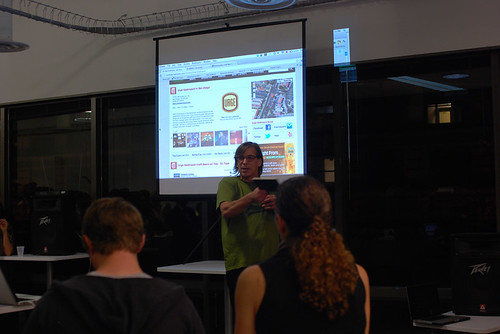
    In all honesty, I was not expecting much out of the demo night as I had heard the San Diego startup scene is small and rumors about evoNexus's difficulty in signing up quality startups to their incubator.  Instead, the demo night far surpassed my expectations.  

    DSC_0043 takelessons
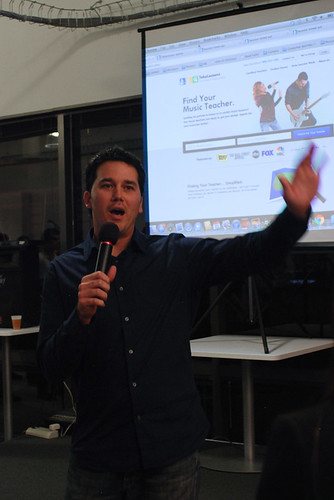
    This was by far the most impressive startup to demo. Though with 90 employees and $6 million in funding it probably should not have demoed next to the other startups that night since many of them were still in the seed stage.

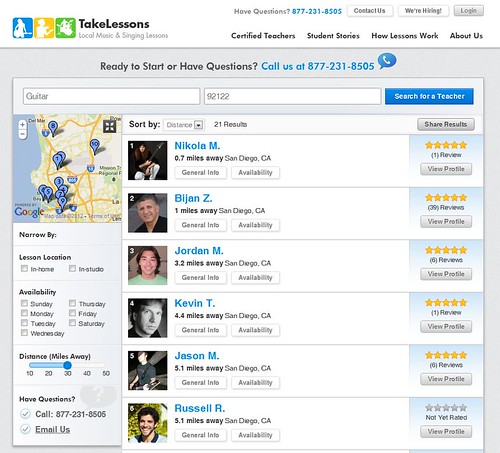
    TakeLessons is a site that helps people find music teachers in their area, kind of like a skillshare.com for music. In addition, it is also a customer relationship management platform for music teachers. Music teachers have to apply to get on TakeLessons.com and get processed through algorithms, that calculate things like how many students the teacher can handle, lifetime amount they will earn as well as the level of competition in the locale. Only musicians who run through the algorithms with a certain score get to be listed on the site.
    I strongly believe in TakeLesson's model and love the idea of simple CRM for music teachers, because as TakeLessons said in the demo, most music teachers just want to teach music.  They do not want to deal with payments, scheduling and marketing, and would gladly pay for a service that would do that for them.  

    With partnerships with Best Buy and now Amazon where buyers of music instruments will get offered a deal or giftcard for Takelessons, I expect to see TakeLessons become a mainstream service in the very near future.  

    DSC_0035
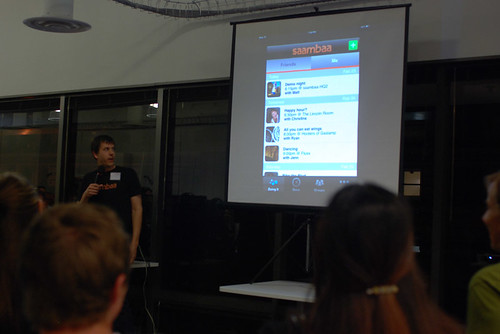
    This was a neat little app that was kind of like a location based Google calendar or Facebook event.  Users go on the app and browse what their friends are doing at that moment them.  In addition, users can make events and invite their friends to them.  Usually, I have qualms about products that require a large user base to work but with saambaa, users can invite people to the event straight off their phone book by SMS meaning that non-app users can participate in the fun as well.

    I am not exactly bullish on saambaa's prospects because there are quite a few location based event planning/discovery apps out there but I do like what I see and will definitely be keeping an eye on them as they attempt to raise.  My only complaint and its a huge one is that the app is extremely unstable, it has crashed on me so much that it is nearly unusable, in addition, it crashed when I tried to sign on using facebook meaning that I had to trudge through the manual registration process.    

    DSC_0008
    Note the "550 days ago" and "Refreshing data from website" 
    Tap Hunter was probably the least impressive out the demo night line up.  Their app allowed users to track the craft brews that their local bar has on tap.  Hearing that I already thought it was a fairly trivial app as not knowing what is on tap is not exactly a huge pain point for most people.  Nonetheless, I was intrigued due to the fact I am currently just getting into craft brews.

    Upon downloading the app, I was hit with a 5+ minute loading time when I launched it, as TapHunter attempted to download information from the server.  I say attempted because my phone locked out because TapHunter took so long to download from the server, the lock out interrupted the download and caused the app not to work.  I had to reinstall the app and make sure it did not lock out again before it finished downloading the second time.  However, the disappointment only deepened when I started using the app and realized my local bar had not updated their selection in 530+ days.  A quick look at the comments in the app showed that information that was outdated for over a year was the norm. 
    Avoid this app.

    DSC_0031
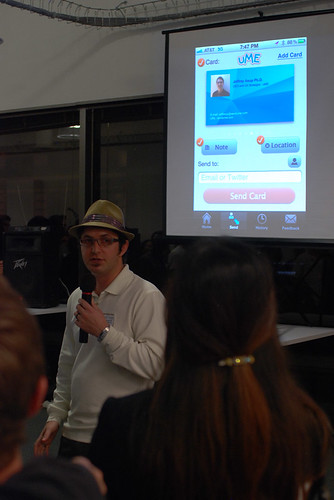
    When I heard that uMe was another one of those business card apps, I dismissed them.  However, when I saw their demo, I started seeing some possiblities.  The founder showed how he could distribute his card to the whole audience by having us just email his uMe address, which I thought was pretty neat and could see being useful in a conference setting.  Distributing uMe cards through was also a great idea because that meant that non-uMe users could receive uMe cards, once again overcoming the critical mass problem that so many apps have.   

    Hard time choosing the lesser evil
    However, once I downloaded the app and actually started using it, I was once again disappointed.  Their UI was plain and maybe even a little ugly. My biggest gripe was the limited number of business card templates all of which were hideous.  The last deal breaker, is the fact that my biggest problem with business cards is not that I never have any on me, but rather of how to organize all the ones I receive.  The uMe app does not solve that problem as I can only receive other uMe cards with the app, which essentially makes it useless because nobody uses the app. 

    Looks I am going to stick with Cardmunch as my business card app of choice.

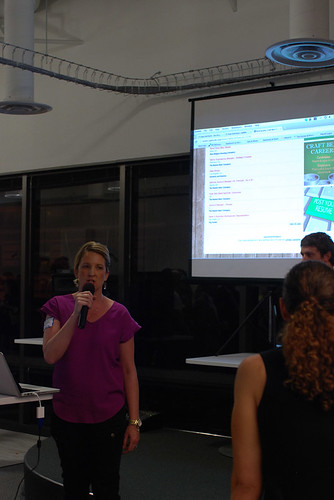
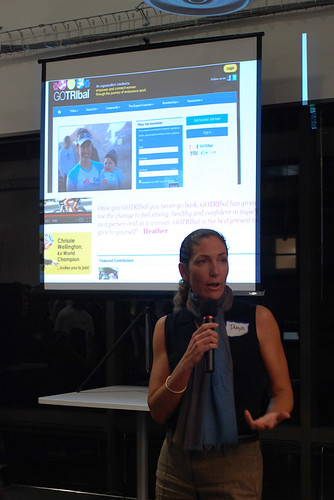
    DSC_0026 Gotribal
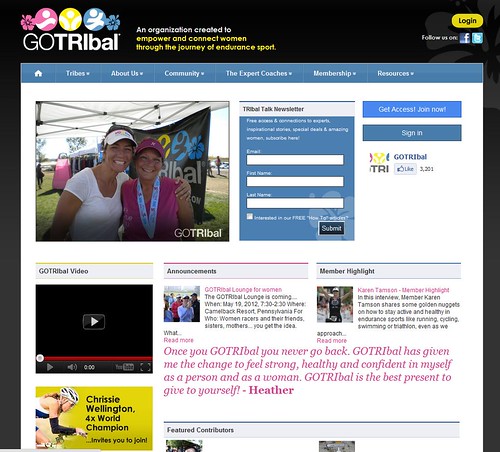
    I don't have much to say about GoTribal because I do not understand their space much.  GoTribal is a social network aimed at women in endurance sports (marathons, triatholons etc.).  Yes, they are that niche of a company.  Though, the founder stated the market was in the millions of women in the US alone and growing at a rapid pace.  Normally, I would be highly skeptical of another social network, but it seems like GoTribal has its affairs in order with a celebrity endorsement, corporate sponsors and an active community. 


    Kareer.me
    DSC_0011
    Kareer
    Unfortunately Kareer.me is mainly filled with jobs no college student wants
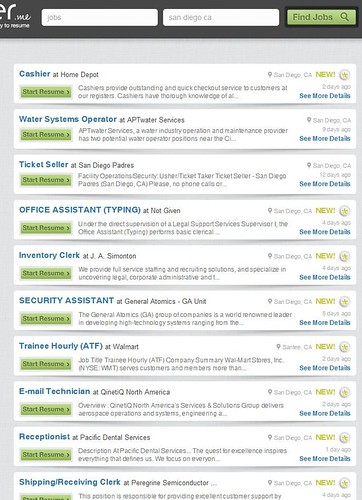
    This startup is looking to remake the resume.  Kareer.me allows you to make a richer resume with video intros, etc and it also allows you to simply make multiple versions of a resume, which is a big plus for people looking to tailor their resumes to each job.  Kareer.me is also a jobs site meaning that users can immediately apply to jobs that companies have posted with their freshly made resumes.  However, when I checked the job listings on Kareer.me it was filled with positions like cashier, dishwasher and clerk which are not exactly the positions that their target segment of college students are aspiring to apply for.

    As one of many startups trying to remake the resume and with nothing to make Kareer.me really standout from the pack, I am bearish on its prospects. 

    Antengo
    DSC_0036
    I wish Antengo had more users!
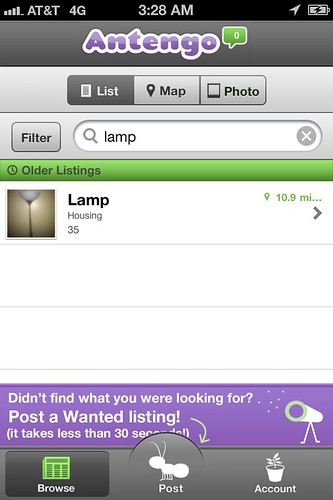
    In a world with the likes of Zaarly and Taskrabbit, the local market place app space is pretty crowded.  Antengo is basically a no nonsense mobile version of Craigslist and for that it works well.  The UI is intuitive (not like Zaarly's redesign) and it looks way better than Craiglist. 

    However, the reason I am not using Antengo over Craigslist right now is because there are very few users!  At the demo, the founder spouted some impressive statistic regarding active users and transactions, but the fact is that I simply cannot find anything I want on Antengo.  Looks like I am going to stick with hideous Craigslist and I bet many others will too. 

    Monday, October 3, 2011

    Daily deal folly at UCSD or just a genius marketing ploy?


    I thought the daily deals marketing concept pioneered by Groupon had already been thoroughly debunked.  However, when I got back to UCSD I heard my friends buzzing about a new daily deals site called Munch On Me.  According to TechCrunch, Munch On Me is an YC startup that is the "Groupon for food."   The “key” difference and advantage Munch On Me has over Groupon is that it gives deals on specific items rather than dollar amounts letting restaurants stock up on a particular item, which leaves them much more prepared to handle the spike in traffic.  It looks like they just recently expanded to San Diego and are offering quite a lot free items on their site.   Munch On Me has even managed to get my on campus Tapioca Express on board.  For over a week, the UCSD Tapioca Express is offering a free pearl milk tea with no purchase necessary. 

    I question what Tapioca Express hopes to accomplish out of this promotion.  The theory behind daily deals is that by driving a massive amount of traffic to a store through a “too good to be true” deal, will result people in discovering the store and then turn them into repeat customers once they realize how awesome the store is.  Munch On Me must have a great sales team to be able to convince Tapioca Express that it needed to be discovered, considering that it is the only milk tea shop on campus with the next closest one being a 10 minute drive, 20 minute bus ride or 30+ minute walk from the center of campus.  In other words, if you are on campus at UCSD, you do not have a choice but to go to Tapioca Express for your milk tea, making the act of running a free milk tea promotion with no purchase necessary, sort of a puzzle.  I reckon money would have been better spent on something as simple as a flyer.       

    This promotion only makes sense, if Munch On Me is paying Tapioca Express for the promotion in order to drive traffic to the site.  As one of the most highly trafficked stores on campus, a Tapioca Express promotion would drive a lot of traffic from UCSD students to Much On Me.  It would be an ingenious way to get that word of mouth effect going overnight.  

    Monday, September 19, 2011

    Bootstrapping Business Trip

    A couple weeks ago I went on what could be called my first business trip ever. Initially, the trip was purely personal; I was going down to LA to see some old faces at the CAUSE intern graduation. I wrote off the three days as lost time, before it dawned on me that I could make this trip into a customer development exercise.

    One of our lunch groups was trying to expand out into cities around the country. The expansion did not go smoothly and had stalled at this time. Los Angeles and San Diego were two of the cities that were part of the expansion, so I decided to schedule meetings with the local organizers and see how we could get the ball rolling once again.

    My first stop was in San Diego, where I sat down for a cup of coffee with one of the writers of the Lean Customer Development books. He was quite frank about the weakness of our value proposition and in no uncertain terms told me to go work on it immediately. Just telling people networking was good was just not cutting it, I really had to spell out the benefits of these lunches.

    Moving forward, the SD organizer advised I set up lunches preemptively and then invite people to the event rather than waiting for the group to reach a critical mass. He explained that people would be more willing to join a lunch group if there was a set lunch to look forward. As for promotion, he suggested I craft boilerplate (pre-crafted) emails to organizers to send to their members that clearly illustrated our value proposition. Then with these emails do an A-B test by sending one email to a half of the group and another to the other half in order to determine what language was the most successful. The key to making these lunches happen was to create a turnkey for the organizers, making the lunch recruiting process as effortless as possible. At the end of our meeting, he invited me to come back and attend his weekly coffee meet up so I could talk to the group members and tease out what would get them to attend a Wednesdays lunch. Needless to say, I left that cafe thoroughly enlightened.

    The next day, I was back on the road and in LA meeting with another organizer. I managed to clear up some miscommunications about the level of involvement for the organizer and ended up getting him on board for the next lunch. It turns out that the LA group only met about once a month and these were usually speaker events. The organizer thought that his members would be interested in bimonthly casual lunches as it would help with networking and community building. After this meeting the attitude of the organizer went from I am too busy/not interested to let us give it a try. What a lesson on the power of in person meetings.

    DSC_0145
    Coffee's for Customer Development

    Back in San Diego, I attended the coffee meetup that the SD organizer hosted, where I met Dave, a member of the group who suddenly made the value of lunch very clear. Dave explained that the entrepreneur by nature is isolated because he has to act as if his startup is doing great and problem free to the outside world. Dave envisioned Wednesdays lunches as a support group for entrepreneurs, a place where they could openly and safely talk about the problems they were having with people who have been there and done that. When I heard that, I thought it sounded like a pretty good tagline for entrepreneurial themed lunches.

    While talking to Dave and the other group members, it dawned on me that this was no different from the anthropological field work that I was used to doing. I was utilizing the same interview and observation skills that I had honed out in the field, doing academic research. Customer development suddenly seemed to be just applied ethnology and the idea of being one’s own customer was nothing more than participant observation.

    The day before my trip started, Startup Weekend (SW) cleared me to go to their LA event and my trip got extended to a whole week. That is how I ended my trip in beautiful Santa Monica, handing out flyers around SW. Not too exciting but it had to be done. There is no insight like the one you get from being on the ground with customers and I relearned that while handing out flyers to people who kept asking me what a lunch club was. The founders and I had always thought that the term "lunch club" was self-explanatory, but after interacting with the SW attendees, I realized that was not the case. So next time on the back of the flyers there will be definitely be an explanation. My trip ended on a high note as I was invited to the front of the stage by the CEO of SW and allowed to pitch the lunch group to all the participants. I could not have imagined a better way to end the trip.

    DSC_0156
    Ending on a high note at LASW