Showing posts with label Shanghai. Show all posts
    Showing posts with label Shanghai. Show all posts

    Friday, February 17, 2012

    Fun Friday: Interview with Andi


    Once in awhile on a Fridays, I am going to start posting up things that show more of my personality, because quite frankly, this blog can get a little dull at times.  This first fun Friday post will be a reposting of  an interview that I just completed for Andi, a good friend that I met in Shanghai.  Andi writes her own blog titled Gullible's Travels (Pretentious Version) where she documents her life as an expat in Shanghai.  When I saw that she was posting interviews of her expat friends, I not so subtly hinted that I wanted to be interviewed too!

    Andi was more than happy to oblige and below is what we came up with:  
    =============================================================
    One freezing, rainy winter evening last year I went to a film screening at Café Vienna and I got seated next to Jonathan. Since we’ve both studied anthropology, lived in Shanghai and were struggling with Mandarin, we had quite a lot to talk about from the very beginning. Since then he went back to California and he’s greatly missed. All photos inserted are courtesy of his.

    Name: Jonathan Lau
    Place of Origin: California
    Time spent in China: 11 months

    Once you invited me to a film screening, organized by a charity organization, at which you were one of the pillar members during your stay. Who are they and have you heard from them lately?
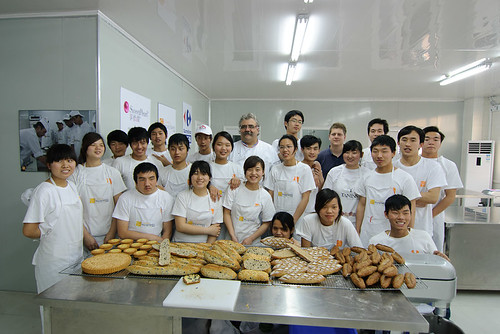
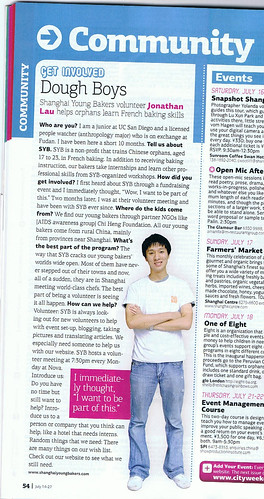
    When I was in Shanghai I volunteered at a non-profit called Shanghai Young Bakers (SYB).  This amazing organization brings orphans aged 17-21 from rural China to Shanghai and trains them in French baking for a year, giving them practical skills for a better future.  I still get their monthly newsletter and the last thing I remember reading was Miss California swinging by the SYB baking center with the Pistachio Growers of American and a $50,000 check.  I think it is safe to say that they are doing very well since I left Shanghai.
    You left Shanghai last July after spending almost one year here, studying Economics at Fudan University.

    You left Shanghai last July after spending almost one year here, studying Economics at Fudan University. Why does a young undergraduate of anthropology choose to read Economics?
    I used to be a double major in Economics not too long ago before I admitted to myself that it was making me miserable.  However, it is hard to separate economics from culture so I often found it in my anthropology.  Not to mention, it helped make sense of the cultural shifts that I was seeing happen in China.

    DSC_0032


    What was your first impression of Shanghai when you first arrived and how has your perspective changed after one year?
    Arriving at Pudong airport and driving to Fudan, I thought that Shanghai looked very much like Hong Kong.  A year later, I realized that only a few parts of Shanghai come close to looking as modern as Hong Kong.  Living in Shanghai, helped me see China as a developing country with a few cracks of modernity.  

    20101114-DSC_0032


    What was it like to go back and leave everything behind in Shanghai after this long break from home?
    Towards the end of my stay in Shanghai, I was very ready to leave.  Being from California, the lack of clean air and good weather was really getting to me.  In addition, my life in Shanghai had become routine and I felt that I was not really growing much anymore.  However, when I got around to packing I started getting choked up.  There is something about putting my life away into boxes or suitcases that just makes me realize the magnitude of what I am leaving behind.    

    What was the most difficult to get used to in the first few months?
    Daily interactions back home in San Jose took some getting used to.  Suddenly, it was no longer appropriate to push past people on the street, sleep walk through my day or speak Chinese.  Reacquiring manners was quite difficult, I kept getting caught off guard whenever strangers talked to me on the streets and struggled to remember to say thank you to shopkeepers.   A friend actually laughed at me because of how awkward I was being around waiters.

    What do you miss the most from Shanghai?
    It did not take much more than a couple of hours of home for the boredom to get to me.  Suddenly, there were no art galleries to visit, bars to frequent, events to attend or even metro to ride.  Leaving that Shanghai lifestyle behind was extremely difficult.
    DSC_0066


    Once I heard there’s not enough hugs in this city. What’s the dating scene like here?
    I would be the wrong person to ask as I never dated or tried in my year in Shanghai. Though I did talk to a few expats and locals about it and the scene seems to be lively but lacking quality.

    Was your stay here successful? Did you achieve what you’d set out back in 2010, before you moved here?
    I came to China really with three goals in mind, to learn Chinese, make Chinese friends and discover what Chinese culture is.  I failed fantastically on the first two goals, most likely because they fed into each other.  However, for the latter I got much more than I bargained for. 

    3 things one has to pack when moving here
      20101217-DSC_0017
    1. A camera - Shanghai is an incredibly photogenic city, especially at night.  To not have a good camera to capture the beautiful though sometimes tacky lights all around the city would be a sin.
    2. Smartphone - Forget phrase books or maps! We are in the 21st century now! Bring your smartphone and preload it with a Chinese-English dictionary and relevant maps.  Watch out for the pick pockets though.
    3. Leatherman/Swiss Army Knife/Multi-Tool - Because everything in China is broken or near broken especially in your apartment. My Leatherman saved my life many times and allowed me to capitalize on the many opportunities for mischief.



    3 things one should never attempt to do if they are newbies here
    1. Barter - No matter how much you have read about bartering you will get ripped off.  Best to go with a pro or local and learn first before attempting to do it yourself.
    2. Leave the city - Resist the urge to hop on the plane to Beijing or Tibet your first month here.  Shanghai is a magical place in its own right and there is no way to fully explore it in just a month.  My philosophy has always been to know your own backyard before even attempting to leave it. 
    3. Work or Intern - Don't jump at the first internship or job that you find as soon as you land in the city. Employers in China have a nasty habit of using somebody for all they are worth.  Take a little time and ask around to get know the employer situation before settling.


    Something that really freaked you out in Shanghai
    Once at a wet market, I saw these frogs being skinned alive.  The horrifying part was that after they were skinned, they were still alive! That box of skinless frogs jumping around was a pretty gruesome sight.

    Is Shanghai expensive?
    Shanghai can be expensive or as cheap as you want it to be, though I definitely lived on the more expensive side.  The expat lifestyle of your own bedroom and going out to bars will probably cost you many times the average income of a local.  However, for the same amount of money I spent in the US, I got much more bang for the buck in Shanghai. 

    What would be the best location for a single newcomer, whirling in the urban mist, desperate for a coffee and a quiet corner to read their paper on a Sunday morning?
    It depends.  If you have an arm or a leg to spare, you can go to Dan Cafe in Tianzifang.  Run by a retired professor from Japan, Dan most likely serves the best coffee in Shanghai, but you are going to have to pay 35RMB minimum per small cup and the sky’s being the limit for how much you want to pay. 

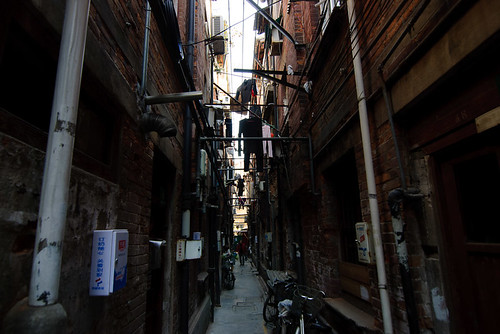
    If you are not rolling in cash, I would probably go to GZ Cafe near the Nanjing Xi Lu metro station.  It's a small cafe run by a very friendly couple in the middle of this side street/neighborhood of shikumen houses.  The coffee is decent and reasonably priced.  The best part though is probably the kittens that they have running around that you can pick up and play with.  They are very helpful on a lonely day.

    If you could use one word to describe your experience of living in a far-away country, what would be it?
    Magical - Everything from the people I met, places I went and things I experienced was inexplicably amazing.  There were just so many moments that just filled me with awe that magical is the only word which does justice for my year in Shanghai.   

    What Chinese word did you use most frequently?
    Dui, because I could enthusiastically say it in rapid succession whenever someone understood my terrible Chinese, which was always a great feeling.

    Are you planning on coming back one day? Why.
    Of course! There is something about Shanghai that I just miss.  Perhaps it's the grittiness of the city, oxymoron that is China, or speed of life, I cannot put my finger on it, but something compels me to go back. 

    Monday, November 14, 2011

    My Networking Story

    Last Monday, I got an email from my boss

    Hey – this just came out. Big kudos to Jonathan for helping!
    http://www.slideshare.net/bowei/the-china-startup-report-a-15min-crash-course-by-bowei-gai
    -H

    It was a link to a presentation on the startup scene in China and on the “Special Thanks” slide was my name.

    Is that really my name there?

    Looking at this slide with my name tagged with 500 Startups, I am amazed by how far I have come. To think that while still in college, I would have meaningful professional connections that could help someone. It just leaves me speechless.

    Just a year ago, I could not drop a name to save my life. There were no relationships with professors or even high school teachers to speak of. Only when I needed a letter of recommendation to study abroad did I have my first real conversation with a professor and that relationship died as soon as he wrote that letter.

    My first attempt at real networking was during my political internship in Los Angeles. The internship coordinator pushed my intern class to go forth and network any chance we got. The plan was for me to collect as many cards as I could while being as memorable as possible and then email the card givers the next day telling them how much I enjoyed meeting them. For my efforts that summer, I ended up with a large collection of business cards, but only one of those cards ever ended up in a meaningful conversation. Something just was not working.

    While studying abroad in Shanghai, I made no effort to network because I believed that it would be meaningless since I would be gone in a year. I started going to networking events for the drink specials and guest speakers, making no effort to schmooze anyone into giving me their business card. Surprisingly, during my stay in Shanghai I made significantly more connections than at any other point in my life.

    Thinking back, I realize there were two reasons for the explosion in connections. First, by not having networking be the end goal of meeting someone, my interactions upon meeting people for the first time became much more genuine. I cracked jokes, talked about my personal life and was just generally much more relaxed. This helped people warm up to me quickly, allowing for a connection to happen organically. Second, I got involved in a non-profit and Toastmasters. Through these two organizations, people would not only see more and more of my personality meeting after meeting, but also see the kind of skills I brought to the table through the work I did for the organization. Cementing everything together was the understanding that we were all working towards a common goal, which made the relationships extra meaningful and more resilient.

    In short, if you want to make meaningful connections, skip the networking events and cocktail parties. Just keep it real and get involved.


    Monday, November 7, 2011

    Study Abroad Advice for China

    20101007-DSC_0023
    Pudong, Shanghai built in just the last 20 years

    From September 2010 to July 2011, I studied abroad in Shanghai (SH) at Fudan University. I experienced a very different China from my classmates and the experience opened up my eyes and radically changed my perception of the country and culture. Recently, I was asked about my experience by a prospective study abroad student who was planning on going to China. The advice I gave her did not seem to do my experience justice so I was compelled to finish this post that has been on draft for weeks.

    This is what I would tell every American student looking to study abroad in China:

    Breadth vs. depth
    Early on you will have to decide what kind of experience you want from China. The amount of time you have is severely limited meaning that you will have to decide between breadth or depth. China is a large country with many sights to see and at the same time is an incredibly complex society with many layers. It is a zero sum game in that seeing sights will mean understanding fewer layers and vice versa.

    DSC_0178
    The class of Shanghai Young Bakers with French master chef Pascal Tepper

    After backpacking for a week, I realized I was not much of a backpacker and opted to spend the large majority of my time in SH. I got involved in a nonprofit called Shanghai Young Bakers, as well as joining a local Toastmasters chapter. A lot of my time was spent exploring and trying to understand different parts of the city. I got off the tourist path and started acting like a resident, attending expat networking events, non-profit fundraisers, gallery openings. I even became a recognized regular at a café!

    20101024-DSC_0003
    Sometimes, the art was in some strange places like this former opium storage facility

    20110112-DSC_0065
    Other times, it just got creepy

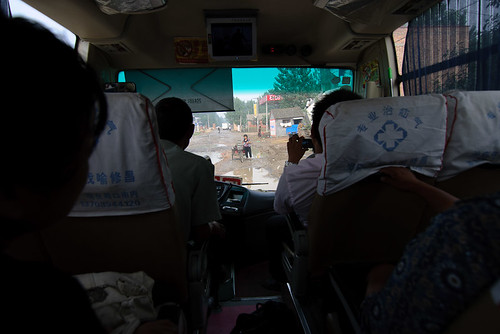
    This all came at a cost, as I skipped out on many of the things people expect you to see while you are in China, like the Great Wall, Forbidden Palace, and terracotta warriors just to name a few. I certainly saw the least tourist attractions out of all my classmates, but I do not regret it as I was able to see a China that was not in the tourist books. For instance, as part of Shanghai Young Bakers I was able to travel through AIDS impacted rural China and hear the stories of working class people my own age.

    DSC_0163
    In rural China, sometimes getting off the beaten path means not much of a path at all

    Learning Chinese
    Not understanding Chinese, does not mean that you cannot get off the beaten path. First tier cities, like Beijing and Shanghai have large expat populations that will allow non-Chinese speakers to do unique and non-touristy things, such as partake in the local art scene. However, not understanding Chinese does severely limit your interactions and understanding of the locals.

    Learning Chinese is an extremely time consuming process that will cut into your time exploring and experiencing the country. My advice for learning Chinese is to skip the university classes, which are largely impractical and instead hire one of the many student tutors. Also focus solely on learning to speak and pin yin, as these will immediately y improve your ability to interact with locals and get around the country. Armed with a smartphone or iPod touch loaded with Chinese-English apps and a rudimentary understanding of Chinese, you will be able to survive 80% of your day to day interactions. For the other 20% just guess and hope for the best, it is more fun that way anyway.

    Do things alone
    The truth is that no matter how many friends you may have, there will be many instances where due to school, work or just general disinterest, they will not be accompanying you to what you want to do. Many times, I found myself at an event or wandering alone in SH, and though it definitely would have been more fun with some company, I never regretted it. Do not wait upon others to do what you want, or else you will miss out on a lot. Also, one plus of going alone is that it opens you up to making new and unexpected friends.

    Hang with non-Americans
    20100912-IMG_1122
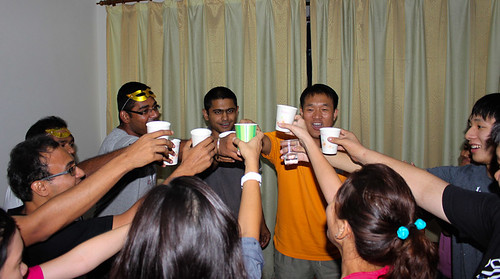
    Nationalities represented at my birthday party: American, Canadian, Chinese, French, Indian, Korean, Singaporean and Thai

    Arriving in a foreign land like China where you do not understand the language, the immediate impulse is to attach yourself with the familiar. I saw this happen with my classmates who mainly hung out with each other in large groups. This did not make much sense to me because I had not traveled thousands of miles to interact with more Californians. Due to my insistence on minimizing the amount of time I spent with Americans, I spent my first semester with a very international group of MBA students and then later with Singaporean exchange students. The most valuable thing I walked away with after a year in China was not the experiences or knowledge, but the friends I made that came from all across Asia.


    Tuesday, July 19, 2011

    Thoughts on TechYizu

    A month ago, I went to startup demo day hosted by a Fudan University incubator. The event was rather disappointing as none of the startups that presented blew me away. In addition, the large majority of presenters including the winner of demo day were foreigners, I had wanted to see more local Chinese entrepreneurs. It also did not help that the local startups had the worst presentations by far.
    There were three startups that stood out to me for different reasons.

    Rudy Bike

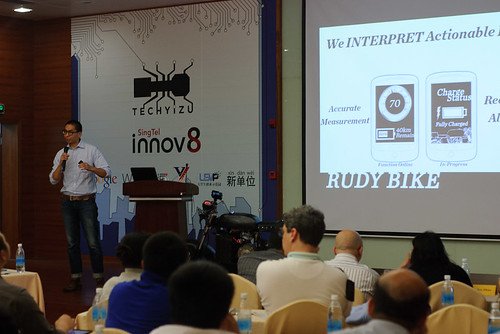
    Rudy Bike has designed a chip that makes electric bikes more efficient, reliable and easily monitored. The chip is compatible with any brand of electric bike and easily installed, (plug and play). An Android phone was required to take full advantage of the chip, as it was paired with an app that would give the user the battery level as well as other features such as a turbo mode that would allow for the bike to go faster at the cost of more energy. They already have a working prototype.

    DSC_0021

    The reason that Rudy Bike stood out to me was not because it was a brilliant product, but rather due to its huge disconnect from its target market. Namely, that it is mainly the lower class in China that ride electric bikes. Rudy Bike quoted the price of its chip to be around 1000RMB, which as one judge on the panel pointed out is about how much a new electric bike cost. If doubling the cost of the bike was not enough, there was also the problem of requiring a smartphone in order to fully utilize the chip, probably adding on another 1000RMB if not more to the final price tag. It is hard to imagine that the typical Chinese electric bike rider would be willing or even capable of paying for a chip that would triple the price an electric bike.

    Mamazuofan

    Self-proclaimed “Airbnb of food,” Mamazuofan is connecting hungry people with home cooked meals near them. Users log on to the site and see what is cooking around them, then they order online go to the chef’s home and pick up their meal. Their site is currently live, though the majority of users are foreigners.

    Mamazuofan’s concept was certainly the most unique at Techyizu, though I doubt the sustainability of it. After one transaction has been completed, the customer could very easily just grab the phone number of the chef and in the future cut Mamazuofan out of the process. In addition, the reason Airbnb works is because the renter of the room does not have to make much of an effort to rent out a room, the same cannot be said about a home cooked meal. I cannot see someone using Mamazuofan part time to supplement their income due to the thin margins and massive amount of prep time it takes to cook.

    Ultratradr

    The winner of demo day, Ultratradr is looking to disrupt the way banks and hedge funds recruit talent. Ultratradr is a game where players practice stock trading. The idea is that the best people in the game will get recruited by banks and hedge funds.

    My concern with Ultratradr, is that banks and hedge funds already have a strong process of recruiting top tier talent from universities. In the US recruiters routinely visit schools and aspiring finance students rub elbows with executives at networking events. I am not sure that the industry is looking for disruption as the process seems to be working quite well. However, the founder did mention that they are targeting small to medium sized firms, so that could put a different spin on things.

    Saturday, July 9, 2011

    Marketing Binder Entry #3: Product Bundling in China

    One of my first experiences of culture shock occurred when I stepped foot into the local Walmart and saw the odd way that products were bundled together for the sake of promotion. What I saw truly baffled me as there were, chocolates bundles with batteries, batteries with a Swiss army knife and my personal favorite and most common, cups of yogurt haphazardly taped to all sorts of dairy products.

    DSC_0034
    Haphazardly taped yogurt

    It would make more sense to bundle products that complement each other, and if it causes consumers to use more of the product then all the better. An example of better bundling would be to bundle a flashlight or battery draining toy with the batteries. I would like to believe that it is all common sense.

    The good news is that the amount of weird bundling has gone down since I came to China. Though after a little searching I still managed to find some Dove body wash bundled with Lipton tea.

    DSC_0030
    After drinking tea, I too have a strong desire to take a shower

    DSC_0021
    Thankfully during my time in China, sensible bundling has become the norm

    More Pictures of Bundles

    Saturday, June 25, 2011

    Update: Old School Mentality on Social Media

    The other day I met up with that bakery owner I had written about a month ago. He clarified that the reason he did not want to expand his social media operations was not because he was averse to criticism (on the contrary he said as a chef he cherished it) but rather a lack of time. I saw that as the honest truth since he works six days a week; I was surprised he even took time out of his day to talk to me, over something as insignificant as a blog post.

    A lack of time is a perfectly legitimate reason not to dive into social media, because the only thing worse than no social media strategy is a half assed one. Facebook and twitter are littered with unused accounts that were started because everyone else was doing it. Once these businesses realized that some actual effort was needed to keep these accounts active, they quickly gave up on them. These dead accounts with posts that are months or even years old reflect badly on the businesses that manage them. With limited resources, social media would not be the first place I would invest in order to start building a web presence.

    Aside from talking about social media, I was very impressed by the bakery owner’s talk about internships. If anybody is looking for an internship in Shanghai where you will not just get used and abused, I highly suggest seeking out this man out. What he will teach you in a span of a year, I have needed multiple years, jobs and internships to learn.

    The only hint I will give for anybody trying to find him is that his shop in Lujiazui makes one hell of a cappuccino for 25RMB.

    Thursday, June 9, 2011

    Bad interviews: An interviewee’s perspective

    I talked about my great interview with Wednesdays, so today let me share a dreadful interview experience.

    Much has been written about bad interviews from the interviewer’s perspective, but in my opinion, the interviewee’s side of the story rarely gets told. A couple of months ago, I had an interview that was absolutely terrible and I would just like to share the experience.

    I was interviewing for an internship position at a start up in Shanghai. Before the interview, I had talked to my professor, who told me that my interviewer was a “bright kid” and recent graduate from Berkeley. However, things started off on the wrong foot, when my interviewer arrived twenty five minutes late. He then proceeded to give one of the worst interviews I have ever had.

    The interview started going downhill after a couple of minutes when I realized I was the only candidate and that this was not really an interview at all, but rather an introduction to the company. From the beginning it seemed that the interviewer was not quite sure what to ask me and was going to accept me so long as I did not exhibit any obvious problems.

    When I asked my interviewer what I would be doing at my internship, his answer was vague at best. He explained that I would be doing marketing, but the details of what kind of marketing escaped him, though what was most concerning was the admission that the company had no marketing goals. From what my interviewer told me, I gathered that he wanted me to create the whole marketing strategy for the company which was not exactly something you ask an unpaid intern to do. At this point, I was having serious doubts about how successful this company was going to be.

    In the middle of describing the internship, my interviewer uttered something along the lines of “a self-driven position where you get as much as you put in.” This phrase is the bane of my existence for any job description, because it loudly states that the employer has no idea what to do with me. In addition, it conjures up the idea that I will be running around the office making copies and getting coffee, where the only time I will be doing anything meaningful is when I discover it myself. At this point in the interview, the interviewer must have sensed my hesitance because he assured me that I would have support from the rest of the team and that they had “some” marketing ideas.

    Towards the end of the interview, my interviewer told me that after consulting with his boss, the internship was no longer going to be paid. Shocked by this admission, I could not help but loudly exclaim my surprise at this job application blasphemy and it took a lot of self-control not to ask him why he was wasting my time. Lying about compensation in a job description is akin to me lying about my experience on my resume, it is the ultimate betrayal of trust in the job application process.

    Needless to say I walked away from that interview with an extremely negative impression of that company.

    Tuesday, May 31, 2011

    Capitalizing on Young Professionals in China

    It is no secret that Chinese culture centers around the family and this fact is taken full advantage of by advertisers who plaster images of happy families onto all sorts of advertisements for all kinds of products. Products are often marketed as something that brings families together or makes the whole family happy. However, there is a large group of Chinese, that are trying to get farther away from their families, not closer and most people are not seeing it. Did I also mention that they have spending power?

    I am writing about the growing number of Chinese young professionals, who have tasted independence in university but are then forced to move back with their parents due to high housing prices. In addition, this group has a lot of disposable income due to the fact that they do not have to pay for housing and only support themselves. I first learned about this group of young independence seekers while talking to an MBA graduate at a nonprofit meeting. He told me that the best part of London, where he did his MBA, was not the culture, people or food but rather the independence he got from his parents. That is when I realized how important independence was for this new generation of Chinese. Slowly, I began to recall conversations that I had with Fudan students where they talked about how great it was to be living on their own in college and being able to make decisions independent of their parents.

    Upon further contemplation, I realized that this want for independence should not be of any surprise to anyone. This current generation of young professionals in China consume American culture in large amounts. American music, movies and television series which strongly stress independence, especially from that of parents, are all incredibly popular with the university crowd in China. In addition, many of these young professionals have experienced life away from their parents in university and also traveled abroad to more independent oriented cultures. Therefore, it should be no surprise that China’s current crop of young professionals value independence from parents more than previous generations.

    Though there is no product that a company can make that will give these young professionals the independence they want, short of housing, capitalizing on this want for independence is possible. Products and services that serve as escapes from parents, such as short vacation packages for them or their parents, should appeal to these young professionals trapped at home. Also any products or services that serve to make the parents more independent from the young professionals will be well received as well.

    Corporations would do well to create or market products and services that satisfy this desire for independence among China’s new young professionals.

    Monday, May 30, 2011

    Old School Mentality of Social Media

    On a sunny Sunday, my friend and I were invited out to a casual lunch by the owner of a famous bakery in Shanghai. The owner was exceptionally friendly, openly sharing his knowledge about networking and marketing.

    For all of his great advice, what struck me the most was how the owner viewed social media. His my profile, my castle mentality meant that he wanted complete control over his social media presence, meaning that he would not tolerate any form of criticism. It was a mentality that struck me as decidedly old school and reminded me of the challenges that I faced trying to get the directors at UCTV to adopt social media. In addition, his “Why let people score on your own goal” attitude was keeping him from creating such simple things as a blog or Facebook page because it would be a huge time commitment to police.

    In my opinion, social media is about opening dialogue and allowing for criticisms to be answered. Facebook pages, twitter and blogs can be used as new channels for customer service. The owner’s attitude towards social media ran counter to what I have heard about his attitude in the restaurant. My friend told me once that when she complained to him about her cake, he immediately took it back, found who was responsible for making it and then immediate corrected the mistake. This act of customer service gave her a great impression of the owner and bakery. There is no reason this kind of great customer service cannot be applied to say a Facebook page, where it would be available for all to see.

    In my experience, there is often a reason for brand bashing and since the owner runs a restaurant which serves amazing cakes and has great customer service to boot, I think his concerns over negative comments are completely unfounded. Not to mention that unjustified criticisms will be dealt with by the bakery’s loyal fans, something which I have seen played out on countless Yelp pages. Fans fighting brand bashing is a phenomenon, which countless companies have discovered upon launching their social media operations.

    As of right now, the bakery only has a presence on Chinese social media sites because they allow for more restrictions on user comments. About half of the bakery’s customers are foreigners meaning that whatever awesome outreach that the owner is doing on social media is only reaching half of its potential. In short, extending the bakery’s social media presence onto Western networks will improve customer service and increase customer-brand interaction as well as bring a host of other benefits that I cannot list out because it would make this blog post too long. Most importantly, all of these benefits can be realized without a significant increase in effort because it would just be a matter of translating and posting on an additional platform.

    I am going to email the owner this blog post, and hope that he reconsiders his social media strategy. If he changes his mind, I will be the first to like the bakery's Facebook page.

    Tuesday, April 19, 2011

    Notes and observations on China

    I have been studying abroad at Fudan University for almost eight months now and recently quite a few people have been asking me “So what have you learned?” Usually the answers that I give out on the spot are lackluster and it gets me to wondering if I have learned anything at all! Last night, while sitting around alone at Burger King, I began to reflect on what I have learned so far.

    Overexpansion

    Much has been written about China’s property bubble, but it is hard to fathom when it is mixed in with news about China’s phenomenal growth. However, when you are actually at ground zero, the bubble seems much more obvious. Walking around Shanghai, row after row of vacant apartment blocks, deserted multi-story luxury malls and redevelopment projects are the norm. At night, pitch black apartment blocks sit right across the street from a construction for yet another new apartment complex. On a typical day at the multi-story luxury malls on West Nanjing road, I may see twenty or so shoppers in the entire mall, but despite this all the stores are fully staffed every day and more commercial centers are planned just one street over at Weihai road. The Shanghai city government has redeveloped an area south of the bund called the Cool Docks, billing it as the next expat hot spot. The Cool Docks have been empty since the day it opened and yet more redevelopment projects are planned with the goal of turning area in between the Cool Docks and the Bund into one giant tourist walkway full of luxury shops.

    It is hard to see how all of this is sustainable given that China is facing growing unemployment and stagnating wages. I get the feeling that the professors I study under are equally as dumbfounded by how China just works despite the growing laundry list of problems. How long can the country keep defying the law of supply and demand? In my opinion, China is a gilded country with new shiny glass skyscrapers and luxury stores concealing the fact that the large majority of Chinese people are just subsisting and in no condition to support such developments. Shanghai is the richest city in China, but even its population cannot sustain the developments that are taking place in the city and to see this all I had to do was step into a mall.

    Shortcomings of Chinese Higher Education

    In the states, the media constantly reports on Chinese super students and how Chinese universities are graduating more students than ever. There is a fear that Chinese graduates are going to dominate America in the very near future and for a while I was in that bandwagon. However, after attending Fudan University, my eyes have been opened to the shortcomings of Chinese higher education.

    For all intents and purposes, I am on vacation while studying in Shanghai as compared to San Diego. The standards at Fudan are lax and the class curve that is enforced throughout the university is extremely generous. The Chinese professors that I have had have been poor instructors and worse of all; many professors who are teaching in English can barely speak the language at all. Chinese academia has not escaped the gilded nature of the country with Fudan offering many more classes in English than it can effectively staff in order to boost its prestige. In addition, after reading a few articles and papers that a prominent Fudan professor wrote, I cannot help but question the quality of the research that is being done in China. These questions of legitimacy are further compounded by the fact that there have been numerous cases of plagiarism involving high ranking university professors.

    Many of the Fudan students I have talked to have a negative view on their classes, describing it as a waste of time. Indeed, that seems to be the case whenever I look into a classroom I see the students either dozing off or reading books not pertaining to class, while the professor drones on. That is not to say that Chinese students are not ambitious, on the contrary to their behavior in class. Outside of class, Fudan students are quite studious and hardworking. Many of the students show up to class because attendance is mandatory and then learn by themselves through reading the textbook. By American standards, Fudan students lead Spartan lives revolving around academics and extracurricular activities that will make them more competitive in the workforce. Sadly, the university does not seem to be keeping up with its students.

    Fudan University is generally considered the third best university in China. Chinese academia only gets worse as one goes down the list of universities. Seeing the quality of Chinese higher education for myself, I now understand why there is such a large number of unemployed graduates. Western universities can take comfort in knowing that Chinese higher education is nowhere near them in quality.

    Final thoughts

    “Seeing is believing” and being on the ground in China has opened my eyes to all the misplaced hype about China. After eight months, the country looks like one giant house of cards, albeit one that unexplainably keeps adding more levels.

    Thursday, April 14, 2011

    Change of Plans

    Today, the CMO of Unilever came to Fudan University to give a seminar of sorts. I had this elaborate plan to audio record the whole proceeding put it on my blog along with comments and analysis.

    However, when I arrived at the building there was a line of students snaking all the way down from the second floor. Even with the help of my friend who was in the Fudan student union, the group organizing the event, I could not get in.

    While roaming the halls of the building wondering what to do, I stumbled upon a Fudan KTV or karaoke competition. So, instead of learning about Unilever's marketing efforts, I spent the night watching Fudan students sing their heart out.


    DSC_0047
    The competition started off pretty seriously with some great voices...


    DSC_0062
    ... but then there was this student who performed kungfu while singing

    In the end, it was all good fun and I made some decent lemonade out of the whole situation.

    Tuesday, April 12, 2011

    Coffee with a PR professional

    A couple of weeks ago, I had coffee with a Ms. Lee, a public relations professional currently working in Shanghai. We discussed the state of PR in China and the effect of government censorship in her work. In addition, like in all my discussions, we touched on what it is like to work in this foreign country.

    I was looking for an internship in PR in to gain some experience, but Lee told me it was best to start my PR career back in the states simply because China’s PR industry is still undeveloped. She explained that PR in China is still very tactical meaning that it is still event driven. In a more developed industry such as the United States, PR is much more strategic. A strategic PR takes into account the message itself and how to craft the message in order to best fit the target audience.

    These observations of the Chinese PR industry really struck me because I could relate it to my work at nonprofit in Shanghai. There was a focus on planning fundraising events without actually thinking about how to create a sustainable program, especially since they were trying to crowd source all of their funding. The message for the project was not very clear, but the nonprofit was not concentrating on solving that problem but rather how to generate publicity.

    Lee gave an interesting angle on Chinese protectionism that I had not considered or read about before. The way that Chinese protectionism manifests itself in the PR industry is in the form of censorship of foreign companies. As the government controls all domestic media outlets, foreign companies sometimes miss out on press coverage. In a worst case scenario, they are attacked in the media and not given a way to respond, which is exactly what happened to Paypal, when ChinaDaily ran an interview from the President of UnionPay stating that all China needed was UnionPay and adding in "More interbank networks will raise the cost of commercial banks and lower their profits."

    On doing business in China, Lee and I had similar observations. We were both shocked by how slow and inefficient Chinese workers were. In addition, we noted that many places were overstaffed and full of redundancies. Since we met at a nonprofit, we touched on the subject of corporate social responsibility (CSR). Her work experience in the work place gave me a better understand of how CSR is perceived by corporations in China, something that I had only read about. Unsurprisingly, there is an undeveloped idea of corporate social responsibility with companies seeing CSR as just giving money rather than a way of doing business or even a way to sustainably give money.

    I walked away from that meeting a much greater understanding of PR than I came in with. It feels good when the time you put into networking produces meaningful results.

    Sunday, April 3, 2011

    One Egg, One Dream: Expat Outreach in Shanghai

    I was connected to the Shanghai Non-profit Incubator (NPI) by Dr. Fung and have since started working with them. I was asked to assist in reaching out to the expat community in Shanghai about the One Egg, One Dream (OEOD) project that Shanghai NPI was working on.

    OEOD was a project that was originally started by Google. The project gave money to a local NGO, which in turn gave rural children one boiled egg per day through their school in order to give them proper nutrition. The Google project was supposed to be just a one off project, but Shanghai NPI decided to continue and expand it once it learned about it.

    I have been asked to find ways to generate interest and fundraise for the OEOD in the Shanghai expat community. This is the quick and dirty about what I am going to do to get the project running.

    1) Translation

    The first order of business must be the translation of the OEOD literature from Chinese to English. However, there is a shortage of English speakers in the NPI team that I am working in, meaning I have to get creative about where to get translators. In the beginning I thought of asking the students in my UC program, but few of them can read Chinese. In addition, due to a lack of incentive or accountability, reliability and timeliness will be an issue.

    Recalling that Twitter and Facebook users translated their respective sites into different languages, I got the idea to try to crowd source the translation. If I break up the literature into bite size chunks and post it in an online community with Chinese and English speakers, maybe the community would translate it especially since it is for a good cause. Currently, the community I have selected is italki.com, a language learning community with many active users who are bilingual in Chinese and English.

    If Shanghai NPI can build a reputation on italki.com, it could reliably use the italki community to translate for their future projects.

    2) Social Media Infrastructure

    Despite being blocked, Facebook is still the best way to reach out to the expat community in Shanghai. Many expat events are still planned and publicized on Facebook. Having a Facebook page with a quick Paypal donation widget will make it easy for expats to find and donate to the project.

    A Twitter profile might also be created; however, the strength of Twitter in my opinion is its mobility, since tweets can be received via text. However, as Twitter is blocked in China that mobility advantage no longer exists.

    A blog might also be in order as Shanghai NPI has their local NGO partners for the OEOD project giver regular updates, albeit in Chinese. Regular updates would greatly increase interest in OEOD and build a following of repeat donors. If crowdsourcing translation works, a regularly updated blog could be a possibility.

    3) Event Planning

    After everything is set up, then the plan is to pursue the fundraising strategy that Shanghai NPI has in mind. In Shanghai, there are a large number of restaurants and bars that regularly host fundraising events for nonprofits. It should not be too difficult for OEOD to find a venue from which to fundraise.

    Tuesday, March 29, 2011

    Starting Subway Sandwiches in China

    A month ago, I headed out to my favorite pub to hear Kurt Lipson, cofounder of Dash Brands, talk about building the Subway franchise in China. His frank and humorous account gave great insight about doing business in China.

    Reintroducing the Sandwich

    “What is a sandwich?” That was the first question that Lipson asked himself when he arrived in China and began building Subway. The answer that Lipson received from focus groups and other sources was far from flattering. To the Chinese, a sandwich was a cheap, cold food made out of triangular pieces of bread and mayo that above all was not very good. In order to for Subway to succeed, Dash Brands needed to change Chinese perceptions of the sandwich. Changing the sandwich from a cold food to a hot one was important as Chinese culture prefers hot food to cold. According to Lipson, the solution turned out to be humorously easy because they just put flames on all their marketing collateral, even if it had nothing to do with what they were advertising.

    Tomatoes, Lettuce and Pirates

    In the beginning, Dash Foods had major problems with their supply chain and pirated stores. The lack of supply infrastructure is a problem that plagues all companies in China. Subway store managers were spending hours calling their tomato and lettuce suppliers trying to secure shipments rather than managing their stores. This problem was eventually solved with the hiring of a logistics company to manage the supply chain of Dash Food’s. Pirated Subway stores was also a huge problem when Dash Foods first entered the region.

    Many of these pirated stores were once legitimate stores whose contracts expired but are still operating under the Subway name. These illegitimate stores look like a normal Subway, but they get their supplies outside of the Dash Foods supply chain, often from the local grocery store. Shutting these illegitimate stores down required working Dash Foods to buy the owners out and at times even work with the slow Chinese legal system. Even now, the job is not complete as there is still a pirated Subway in Lujiazui, the financial center of Shanghai.

    Learning from Mistakes

    Lipson shared a marketing mistake they made three years ago while trying to run a viral online marketing campaign. The campaign generated high amounts of traffic to the website but that traffic did not convert into coupon use and sales. Monetization of internet traffic is still a major issue for companies today and I can only guess at how developed Dash Food’s approach was three years ago. Lipson cites the lack of a key performance indicator and the undeveloped nature of internet marketing for the lack of success.

    One business mistake that Lipson mentioned which seems to be a mistake shared by all foreign companies in China is the issue of expansion. Seduced by the size of the market, foreign companies rush to expand in China without properly researching the market, resulting in failures from a lack of demand. Lipson admitted to a lack of due diligence when the Dash Foods was involved in their own fast expansion. He gave one example of a Subway that they set up in Changsha, a second tier city. Dash Foods was struck by the beautiful state of the art mall that they were opening the new Subway. After a few months, it became very clear that the shiny new mall would stay empty for the foreseeable future.

    Doing business in China

    The most memorable story that Lipson told dealt with the opening of the East Nanjing Road Store, a major tourist destination in Shanghai. Everything was going well up until the health inspector arrived and told Lipson and company that they could not open the store, due to a laundry list of nonsensical reasons, such as the heating unit being too close to the refrigerated food and the need for a clear divide between the customer and food prep section. These reasons had never been a problem at past openings, so Lipson and his partners knew that there was more to what the inspector was saying. What happened next, is what Lipson called the cost of doing business in China. Lipson and his partners took the health inspector out and partied with him all night. No expense was spared to make the inspector happy and in the end the store was allowed open. In addition, the health inspector became a good friend and every Chinese New Year Lipson and his partners are invited over for dinner.

    Conclusion

    Reading about doing business in China pales in comparison to hearing from someone who has actually done business in China. Though I imagine actually doing it yourself is the most exciting of all.